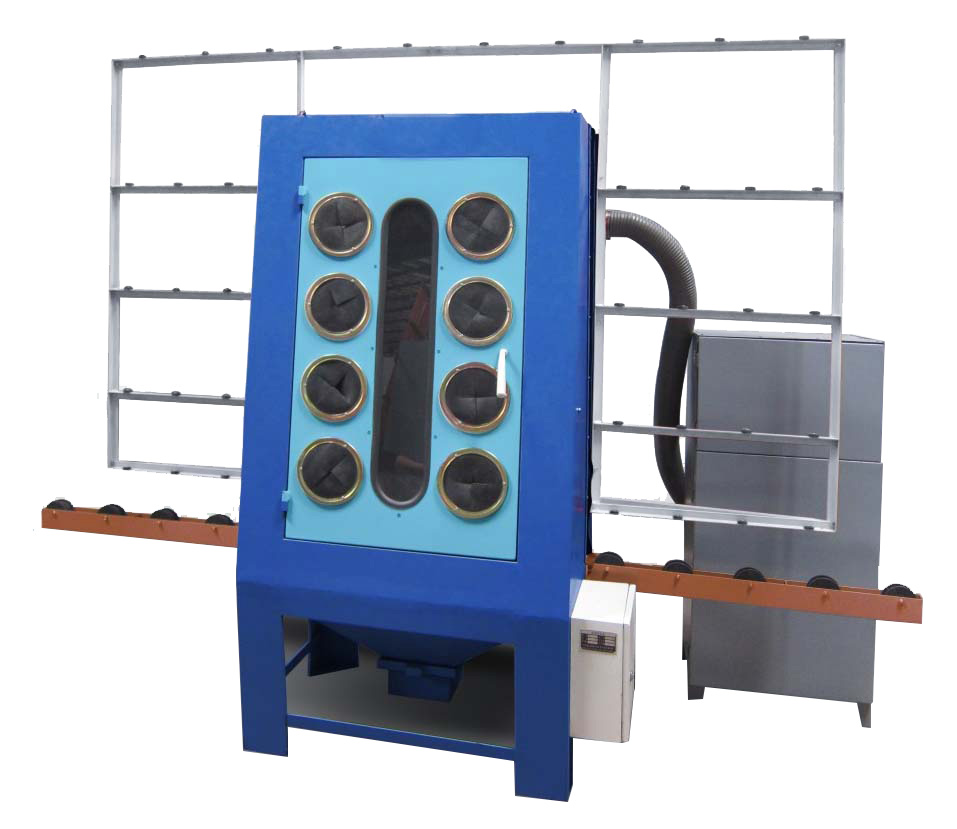
A hand-operated glass sandblasting cabinet for shops that do not have the volume — or the repeatability — to justify an automatic machine. The operator loads the glass by hand, reaches through the glove ports, and blasts with a hand-held gun while watching the surface develop.
Is this the right machine for you?
The honest test is volume and variety. An automatic machine pays for itself in labour when you run the same job repeatedly. If you do not, it sits idle and you have tied up capital and floor space for nothing.
The AS15M fits if you
- Do low or irregular volume — a few panels a week rather than a few an hour
- Take on varied one-off work: samples, repairs, restoration, custom pieces
- Need to judge the finish by eye as you go, rather than programme it
- Blast shapes and edges that an automatic cycle handles badly
- Have limited capital, or limited compressed air — this machine runs on a 10 HP compressor, not 30 HP
You want the automatic machine instead if you
- Run steady repeat production — the labour saving is real and it compounds
- Need consistency between panels that does not depend on the operator
- Process panels taller than 1500 mm or longer than 2000 mm
- Are frosting full surfaces rather than working on details
If you are not sure which side of that line you are on, tell us what you make and roughly how much of it. We would rather talk you into the cheaper machine than sell you one that does not earn its keep. See the automatic AS series for comparison.
How it works
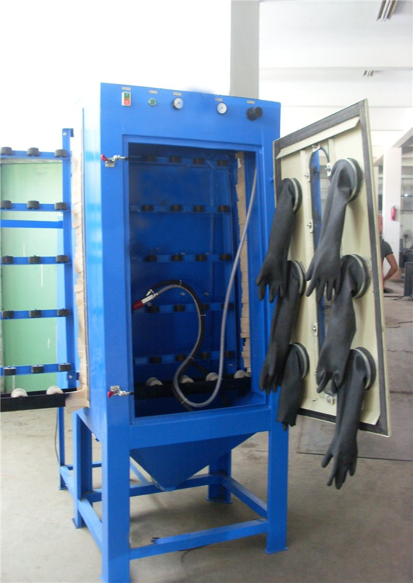
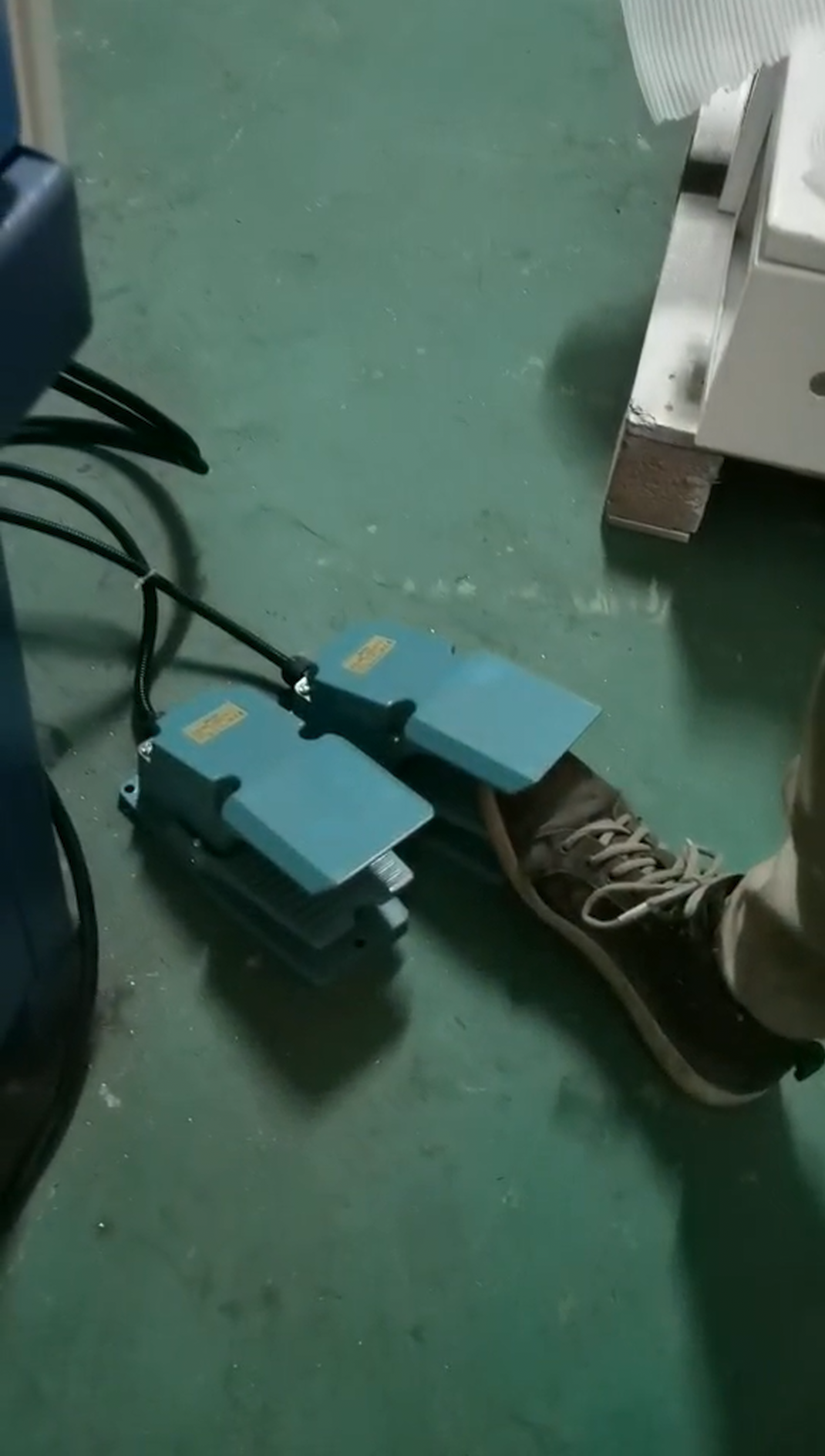
Glass rests on the support rails and is pushed by hand into the cabinet. The operator works through the glove ports, watching through the centre window, and triggers the gun with a foot pedal so both hands stay on the work.
The cabinet is open at the top. A panel taller than the cabinet stands proud of it rather than being blocked, so oversize work can be blasted in two passes with the panel turned end over end.
Spent abrasive falls to the hopper and is collected; the dust extraction unit runs automatically whenever the machine is on. Abrasive is ordinary aluminium oxide — the same brown fused alumina the automatic machines use.
Technical data
| Operation | Fully manual — hand loading, hand-held gun |
| Spray gun | 1, hand-held, foot-pedal triggered |
| Maximum glass size | 1500 × 2000 mm · 59 × 79 in |
| Glass thickness | 3 – 19 mm · 1⁄8 – 3⁄4 in |
| Cabinet design | Open top — oversize panels can be blasted in two passes |
| Machine dimensions | 3200 × 1500 × 2100 mm · 126 × 59 × 83 in |
| Gross weight | 400 kg · 880 lb |
| Total power | 1 kW |
| Working pressure | 0.6 – 0.8 MPa · 87 – 116 psi |
| Air consumption | 1 m³/min · 35 CFM |
| Recommended compressor | 7.5 kW · 10 HP |
| Dust collection | Included, automatic |
| Abrasive | Aluminium oxide (brown fused alumina) |
The compressor is the number that matters most. At 1 m³/min this machine runs on a 10 HP compressor — roughly $1,500 to $3,000 in the U.S. The automatic machines need 30 HP, which is $4,000 to $8,000. For a small shop that difference is often larger than it looks on the machine price alone.
AS15M compared with the automatic machines
| AS15M (manual) | AS16A / AS20A / AS25A (automatic) | |
|---|---|---|
| Operation | Hand loading, hand-held gun | Touchscreen programmed, 3 automatic guns |
| Max. glass | 1500 × 2000 mm | 1600–2500 mm high, up to 3660 mm long |
| Glass thickness | 3 – 19 mm | 3 – 50 mm |
| Throughput | Depends entirely on the operator | 25 m²/h |
| Air consumption | 1 m³/min · 35 CFM | 3 m³/min · 106 CFM |
| Compressor needed | 7.5 kW · 10 HP | 22 kW · 30 HP |
| Power | 1 kW | 3.5 kW, three-phase |
| Weight | 400 kg | 1000 – 1300 kg |
| Consistency | Operator-dependent | Repeatable between panels |
| Best for | Low volume, varied work, details | Steady repeat production |
These are different tools, not better and worse ones. A shop doing twenty identical shower panels a day should not be running a hand gun. A shop doing five varied pieces a week should not be tying up capital in an automatic line.
Electrical supply
The AS15M draws 1 kW. There is no special service requirement — it is a smaller load than most shop tools. Tell us your supply when you enquire and we build it to match: 220V / 60 Hz for North America, 380V / 50 Hz for China and most of Asia, 415V / 50 Hz for Europe, the Middle East, Africa and Australia. Other combinations are built to order at no additional machine cost.
As with any blast machine, plan your electrical service around the air compressor, not the machine. A 10 HP compressor is the real load here.
Warranty, parts and support
Electrical components and motors carry a two-year warranty — twice the one-year term standard for this class of machine. Wear parts and consumables are not covered, and neither is damage from running the machine outside its stated air, power or environmental limits.
Wear parts on this machine are few: the gun, the nozzle, and the abrasive and air hose. They are made to our own specification and come from our factory rather than a local supplier, but they are inexpensive and ship by air, typically 3 to 5 days door to door.
Installation guidance, operator training and troubleshooting come from the U.S. during U.S. business hours, by phone, WhatsApp or video. Full terms on Warranty & Support.
Shipping and lead time
Gross weight is 400 kg (880 lb) — light enough that freight is a much smaller line item than on the automatic machines. HS code 8424.30.0000. ArtCut handles customs clearance.
Machines are built to order: typically 10 to 30 days to produce, plus 20 to 30 days ocean transit depending on coast. Full detail on Shipping & Lead Times. Ask us for crate dimensions when you request a quote — we will confirm them with the current build before you book freight.
Frequently asked questions
Can I blast panels bigger than 1500 × 2000 mm?
Taller, yes — the cabinet is open at the top, so a panel can stand proud of it and be blasted in two passes with the glass turned end over end. Feather the overlap at the joint with lower pressure, and test on scrap first, because blasted glass etches cumulatively. Wider is harder, because the panel has to be supported and moved by hand. If oversize work is routine, the automatic machines are the better answer.
What compressor do I need?
At least 1 m³/min (35 CFM) at 0.6–0.8 MPa (87–116 psi) — in practice a 7.5 kW / 10 HP compressor with a receiver and an oil/water separator. Dry air matters: moisture makes abrasive clump and clog the feed hose, which shows up as an uneven finish and looks like a machine fault when it is not.
What abrasive should I use?
Brown fused alumina in common grit sizes. Grit choice controls how fast you cut and how fine the finish looks — see the abrasive grit size chart. Silicon carbide also works but costs two to three times as much for a finish that is very close.
Can I do masked patterns on this machine?
Yes, and it is a good fit for detail work. Cover the areas you want to stay clear with sandblast resist masking film, blast the exposed glass, then peel. For repeat patterns you will want a plotter to cut the film — see the film cutting plotter.
How much can one operator produce in a day?
We are not going to give you a number, because it depends almost entirely on the work and the operator. Full-surface frosting of simple rectangles is fast; detailed masked work on shaped pieces is not. If you send us a representative job we will give you an honest estimate rather than a best case.
Can it blast anything other than glass?
Mechanically yes, but this cabinet is built around flat glass handling — the rails, the working height and the dust system all assume panels. If your main work is metal parts or small three-dimensional items, a general-purpose blast cabinet will serve you better and cost less.
Ready to talk about your work?
Tell us the sizes you run, roughly how much of it, and what finish you are after. We will tell you whether this machine fits — or whether it does not.
Related
- Automatic Glass Sandblasting Machine — the AS series, for steady repeat production
- Vertical vs Horizontal Glass Sandblasting — which orientation suits your shop
- How to Choose a Glass Sandblasting Machine — the five questions that decide
- Abrasive Grit Size Chart — 24# to 120#, and the finish each produces
- Sandblast Resist Masking Film — for masked and partial designs