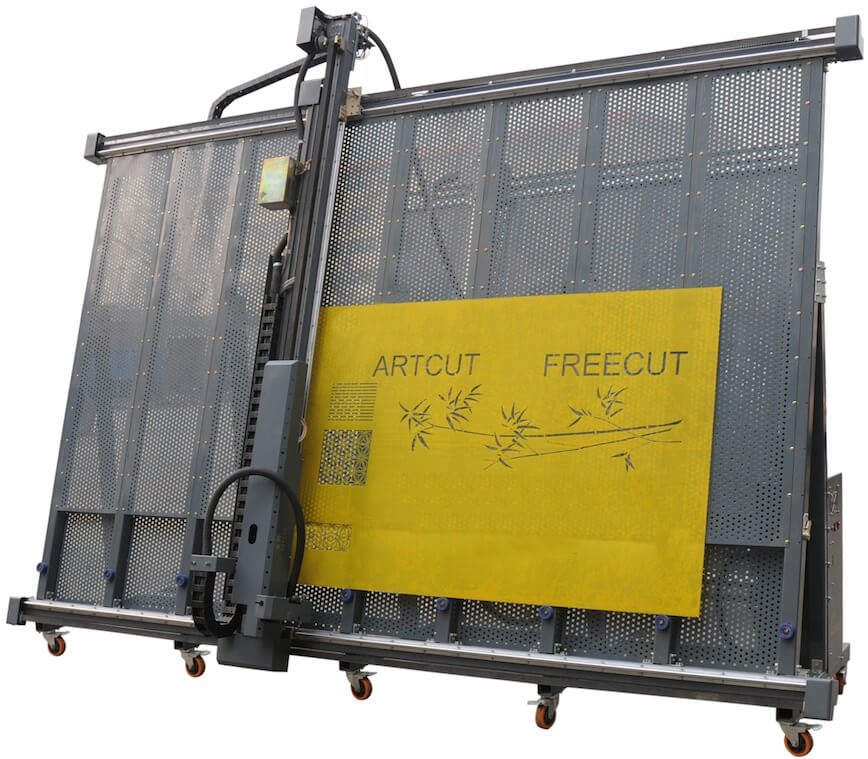
The head on our vertical glass film cutting plotter takes a pen as readily as it takes a blade. We built the machine to cut sandblast stencils on glass. One of our customers has never cut a stencil with it. Swapping between blade and pen takes seconds.
The short version
A painter bought one of these machines and uses it to draw, not to cut. The blade holder comes out, a pen clamps into the same head, and the machine plots vector artwork at full canvas scale onto paper or canvas. No glass, no film, no sandblasting anywhere in the process.
We did not design it for that. But enough of the reasons it works are structural rather than accidental that it is worth writing down properly, rather than leaving it as a line item in a spec table.
Why a glass machine happens to suit studio work
It draws at the size you actually work at
Most pen plotters sold to artists are desk-scale machines. This one was built around architectural glass panels. The smallest standard model has a working area of 1200 x 1830 mm (roughly 47 x 72 in), and the range runs up through 1830 x 2440 mm and 2000 x 2440 mm to 2000 x 3300 mm, with larger tables built to order. Smaller than 1200 x 1830 mm is possible as a custom build, at some additional cost. A full-size canvas is an ordinary job for this machine, not the limit of what it can reach.
The line is consistent, and it repeats
Pen pressure stays even across the working area and positioning is accurate, including on repeat runs. Plot the same file a second time and it lands on the same lines. That is what makes editions and repeated motifs practical rather than approximate.
It stands up
An upright machine occupies a strip of wall rather than a table. In a glass shop the argument for that is floor space. In a studio paying city rent it is the same argument, only sharper.
It reads the files you already have
The machine works from standard vector files. If your composition already exists as output from design or 3D software, getting it onto the surface is a file export rather than a projector, a grid and an afternoon.
Three things a studio can do with it
- Full-scale transfer. Plot the composition directly onto the canvas, paper or board, then paint over it. This replaces projector tracing and grid transfer, both of which lose accuracy as the work gets larger and neither of which repeats exactly.
- Masks for hard-edge work. Put the blade back in and the machine cuts vinyl masks. For flat colour fields and hard edges, a cut mask does in one pass what tape does in twenty. If you use a specific frisket or masking material, tell us which one and we will confirm it before you order.
- Editions and repeats. The same file plots identically the tenth time. If your practice involves series, repeated motifs or multiples, that consistency is the whole point.
Where this stops being the right tool
We would rather say this plainly here than have you discover it after a machine has crossed an ocean.
- It is industrial equipment, not an art product. There is no consumer app. It expects vector files and someone comfortable running a machine.
- It is built to order and ships by sea. Typically 10 to 30 days production plus 20 to 30 days ocean transit. This is not something you order for a show that opens in six weeks.
- It draws lines. It does not paint. Fills, washes, texture and pressure variation are still yours.
- If your work fits on a desktop cutter, buy a desktop cutter. The case for this machine begins at sizes a desktop machine cannot reach.
What we need from you to answer honestly
- What you draw on: paper, canvas, board or panel, and the largest size you work at
- What you want to draw with: pen, marker, pencil or brush pen
- What your artwork is: vector files, raster images, 3D renders or something else
- Whether you also want blade cutting for masks, or pen only
Send those four things and we will tell you whether this machine suits the work. If it does not, we will say so — we would rather lose the order than have a machine sitting unused in a studio.
Specifications relevant to studio use
| Smallest standard working area | 1200 x 1830 mm (roughly 47 x 72 in) |
| Other standard sizes | 1830 x 2440 mm, 2000 x 2440 mm, 2000 x 3300 mm; larger by request |
| Custom sizes | Smaller than 1200 x 1830 mm is possible as a custom build, at additional cost |
| Head options | Blade, pen, or optional laser. A pen clamps into the same head as the blade |
| Orientation | Vertical. Working surface is upright |
| Holding the material | Ordinary masking tape or push pins |
| File input | Standard vector files |
| Wear parts included | Roughly three years of normal production |
| Warranty | Five years on motors, control system and drives |
| Lead time | 10 to 30 days production, plus 20 to 30 days ocean transit |
| Support | Installation guidance, training and troubleshooting from Tucson, Arizona, during U.S. business hours |
Questions we get asked
How does the pen mount?
It clamps into the cutting head, in place of the blade holder. Nothing is modified and nothing is permanent. Swapping back to a blade to cut film takes seconds.
How do I hold paper or canvas on an upright machine?
Ordinary masking tape or push pins. There is no vacuum bed to buy and no special mounting system to learn.
How consistent is the line across a large sheet?
Pen pressure is even across the working area, positioning is accurate, and repeat accuracy is high. Running the same file again puts the pen back on the same lines.
Is this just a big vinyl cutter?
Mechanically it is a close relative, and we would rather you knew that. What differs is working width, the upright format, and the fact that it is built for daily production rather than occasional use.
Can I use it for glass later?
Yes. That is what it was built for. A blade head and a roll of sandblast resist masking film is all that stands between drawing and cutting stencils for etched glass.
Who supports it once it arrives?
Wear parts for this machine are made to our own specification and come from the factory rather than a local industrial supplier. They are inexpensive, and they ship by air — typically 3 to 5 days door to door — so a worn part does not mean waiting on ocean freight. Details on Warranty & Support.
Talk to us about your work
Describe what you make, how large you make it, and what you want the machine to hold. We will give you a straight answer about fit before we quote anything.
Related
- Vertical Glass Film Cutting Plotter — the full product page, sizes, options and technical data
- Sandblast Resist Masking Film — what the blade head is normally cutting
- Shipping & Lead Times — how long a built-to-order machine actually takes